

Sindicato de trabalhadores lança relatório sobre o tema das desigualdades na europa
A desigualdade é apresentada como "It is in fact the product of an economic model that, for the past three decades, has progressively redistributed less and less wealth to the bottom percentiles of society, while accumulating more and more at the top. In other words,"
A leitura pode nos ajudar a refletir sobre a desigualdade na terra Brasilis.
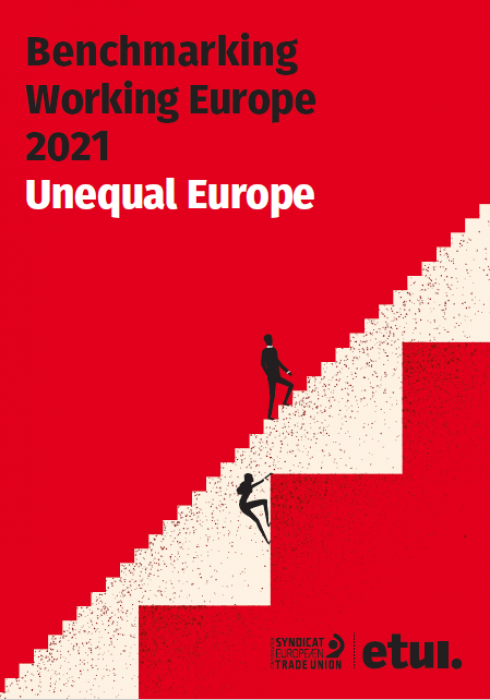
It has almost become a cliché to say that the Covid-19 pandemic has exacerbated pre-existing inequalities while also generating new ones. However, the following pages of this year’s Benchmarking Working Europe clearly reveal that, far from being a platitude, the nexus between the pandemic and rising inequalities is both increasingly measurable and alarming. But they also stress that inequality is not just a one-off historical incident linked to a particular crisis. It is in fact the product of an economic model that, for the past three decades, has progressively redistributed less and less wealth to the bottom percentiles of society, while accumulating more and more at the top. In other words, it is a structural problem. Given the corrosive impact that inequalities are having on the social and economic, let alone political and democratic, fabric of our societies, the policy responses to the problem of inequality must be equally structural in character.
Destaco conteúdo:
Foreword ................................................................................................................... 4
Key messages ........................................................................................................ 12
Guest editorial: Unequal Europe ................................................................. 15
1. Macroeconomic and financial developments and policies in the EU in 2021 .... 25
2. Labour market and social developments: crisis further entrenches inequality . 45
3. Wages and collective bargaining: is social Europe really back on the agenda? .85
4. The inequality pyramid of climate change and mitigation ...... ..... 109
5. Occupational health and safety inequalities in the EU ........... ....... 133
6. Industrial democracy and inequality ........................................ .......... 157
7. Towards a societal resilience ..................................................... .............175
List of figures ...................................................................................................... 186
List of authors .................................................................................................... 190
Vejam também as mensagens chaves
Key messages
Guest editorial: Unequal Europe
In the midst of all the talk about how to build back better after Covid-19, it is important to be aware of all the evidence we have from before the pandemic linking economic inequality to a wide range of health and social problems. The impact of Covid-19 has been shaped by inequality, and the pandemic has shone a light on entrenched and interacting inequalities and the deep suffering they cause. Lack of power and democratic agency amplify inequality and lie at the heart of the problem. Giving people power and reforming capitalism are thus essential steps to creating better societies – for people and for the planet.
1. Macroeconomic and financial developments and policies in the EU in 2021
European economies returned to real output growth in 2021. The pandemic period was marked by a downwards divergence in income per capita between EU Member States. However, the share of people at risk of poverty was lower in 2020 than in 2019 in the vast majority of Member States, illustrating the potency of the extraordinary public support programmes that were launched to mitigate the impact of reduced employment on incomes. The EU economic governance framework is currently under review as the Recovery and Resilience Facility is being deployed, while the European Central Bank has recently adopted a new monetary policy strategy, this time more employment- and climate-conscious, which is to be reviewed again by 2025. The economic policy response to the crisis has shown that where there is a will, there is a way. However, it remains to be seen whether these fresh perspectives will survive the aforementioned reviews to create policy frameworks that can tackle the challenges of inequality and the just transition.
2. Labour market and social developments: crisis further entrenches inequality
The Covid-19 pandemic interrupted the progress that was being made in terms of growing equality and employment across Europe. Despite the efforts made to limit employment losses, unemployment and inactivity rose, and we are now facing a very real risk of increasing long-term unemployment after the pandemic. Furthermore, the costs of the pandemic have not been distributed equally, falling disproportionally on the most vulnerable workers – the young and lower educated – who are overrepresented in the most hard-hit industries. In most Member States, moreover, inequalities regarding age, education, and migrant status increased during the pandemic. It is thus of crucial importance to put equality at the heart of the post-pandemic recovery and a stop to these trends.
3.Wages and collective bargaining: is social Europe really back on the agenda?
During the pandemic, wage inequality increased considerably – not only between the bottom and the top of the wage distribution but also between women and men. Adequate minimum wages that fulfil the double decency threshold of at least 60% of the median wage and 50% of the average wage, along with strong collective bargaining with a coverage of at least 70%, can make an important contribution to addressing the problem of growing wage inequality. It is therefore imperative that the proposed directive on adequate minimum wages is not watered down. A strong directive that fulfils the above-mentioned criteria would not only improve the situation of 25 million workers that currently cannot make a decent living from what they earn, it would also send a strong political signal that European and national policymakers are serious about putting ‘social Europe’ back on the agenda.
4. The inequality pyramid of climate change and mitigation
Climate-related inequalities have multiple dimensions and layers, which interact in complex ways. While the richest 10% of the EU population is responsible for the same amount of GHG emissions as the bottom half, it is the poorest – who are also those who have the lowest adaptive capacity – who will be hit the hardest by climate change and pollution. To prevent runaway inequality due to a climate catastrophe in the future, ambitious climate policies are needed now. However, these policies also risk having unequal effects in the short term, and this must be addressed by ensuring that the transition to net zero is a just one. This is the only way to prevent the sorts of spiralling inequalities which, in a few decades time, may well end up in a disastrous scramble for a lifeboat that is too small to accommodate all.
5. Occupational health and safety inequalities in the EU
The pandemic has had a major impact on occupational safety and health (OSH) for different groups of workers, exposing inequalities in workplace protection. The brunt of the crisis has primarily been borne by individuals in the most vulnerable situations, particularly along occupational and socioeconomic divides. Female gender is also a common denominator for high exposure to hazards and risks in frontline jobs as well as in telework. The current discrepancy between the legal right of workers to be safe at work and their actual lived reality proves that OSH must be an integral part of workplace policy planning, work organisation and employment policy. To ensure a more equal protection of workers, it is crucial to maintain and further develop good regulation at the EU level.
6. Industrial democracy and inequality
New evidence from the Cambridge Leximetric Database has shed light on the relationship between industrial democracy and inequality. While improvements to workers’ codetermination and related representation rights began to plateau across EU Member States after 1990, the rights of shareholders were significantly strengthened. This means that, relative to the protection given to the interests of shareholders within managerial decision-making, that given to workers’ interests underwent a marked decline. This trend is related to the increased share of corporate earnings diverted into dividends and share buy-backs at the expense of wages. There is no evidence that this benefits productivity or innovation in any way – if anything, the opposite is true.
The year 2021 has been a moment of reckoning on the issue of climate change: the ominous future that the Intergovernmental Panel on Climate Change has been talking about for three decades is now the present. The climate transition is already proving to be more brutal than was expected even a few years ago, and it is taking place in a context disrupted by a pandemic that seems to be turning into a long-term endemic phenomenon. In the face of so much uncertainty, the concept of societal resilience is an invaluable tool to prepare our societies for the radical transitions to come, but building it will depend on two essential precursors: social justice and social cohesion.
- Efetue login ou registre-se para postar comentários